

Open Back vs Closed: Which Headphones Fit Your Life?
If you listen mostly at home in a quiet room, open-back headphones will sound better. If you listen on trains, in offices, or anywhere other people exist, closed-back headphones are the only sensible choice. That’s the whole decision, boiled down to one sentence, and everything else in this guide just explains why.
The tradeoff comes down to a handful of factors that matter far more than brand or price tag:
- Isolation vs. soundstage: closed-back cups block outside noise and keep your music private; open-back cups vent that same sound outward, which is what gives them a wider, more natural soundstage.
- Bass character: closed designs reinforce low frequencies inside a sealed chamber, while open designs tend toward faster, tighter bass with less physical impact.
- Leakage: open-back headphones leak enough sound that someone sitting a few feet away can often make out what you’re playing, according to What Hi-Fi?.
Key Takeaways
Open-back headphones win on soundstage and comfort for quiet environments, while closed-back headphones win on isolation and portability everywhere else.
| Point | Details |
|---|---|
| Match type to environment | Choose open-back for quiet home listening, closed-back for commuting or shared spaces. |
| Bass behaves differently | Closed-back reinforces low frequencies; open-back trades slam for tighter, faster bass. |
| Leakage is the dealbreaker | Open-back leaks enough for nearby listeners to hear your music, making it unsuitable for public spaces. |
| Semi-open varies by model | Treat semi-open as a case-by-case compromise, not a guaranteed middle ground. |
| Consider owning both | A closed-back pair for travel and an open-back pair for home covers most listening needs. |
| Closed-back for daily carry | Egwat’s ANC over-ear models target the isolation and portability closed-back buyers need most. |
Table of Contents
- Open Back vs Closed Back: A Quick Comparison Table
- What Are Open-Back Headphones?
- What Are Closed-Back Headphones?
- Why Two Headphones With Similar Specs Can Sound So Different
- Which One Should You Actually Buy?
- How Do You Audition Headphones Before Buying?
- Frequently Asked Questions
- Sources
Open Back vs Closed Back: A Quick Comparison Table
| Dimension | Open-back | Closed-back | Semi-open |
|---|---|---|---|
| Best for | Quiet home listening, mixing | Commuting, office, calls | Shared quiet spaces |
| Soundstage & imaging | Wide, airy, precise placement | Narrower, more centered | Moderately wide |
| Bass character | Fast, tight, less physical slam | Reinforced, punchier low end | In between, model dependent |
| Isolation / leakage | Almost none, leaks heavily | Strong isolation, minimal leak | Partial isolation, some leak |
| Portability / travel | Poor, mostly wired, fragile | Strong, often foldable and wireless | Variable |
| Studio suitability | Great for mixing, poor for tracking | Good for tracking with mics | Rarely used in studios |
| Comfort & heat | Cooler, better ventilation | Can trap heat over long sessions | Moderate |
| Typical price / availability | High-end wired dominates | Wide range, more wireless/ANC options | Fewer models overall |
What Are Open-Back Headphones?
Open-back headphones use earcups with vented or perforated backs, so sound waves from the rear of the driver escape instead of bouncing around inside a sealed chamber. That venting is the entire story: less trapped air means less resonance coloring the sound, which is why open-back designs consistently produce a wider, more natural soundstage than sealed alternatives.
The upside list is short but significant: wider imaging, more natural timbre, lower internal air pressure against your eardrums, and noticeably better comfort during marathon listening sessions. The downside list is just as blunt. You get little to no isolation, heavy sound leakage, and cups that tend to be more fragile and harder to travel with.
Where open-back earns its keep:
- Critical listening at home, alone, in a room you control.
- Mixing and mastering in treated, quiet spaces.
- Spatial gaming where hearing footsteps at a distance matters.
- Long desktop sessions where heat buildup would otherwise become annoying.
What Are Closed-Back Headphones?
Closed-back headphones seal the earcup completely, trapping the rear sound wave inside the enclosure. That containment reinforces low frequencies, which is why closed designs tend to hit harder in the bass, and it also blocks external noise from leaking in or your music from leaking out. Rtings notes that sealed earcups provide substantially better passive isolation, which is the entire reason closed-back exists as a category.
The advantages are practical: real passive isolation, minimal leakage, punchier bass, and designs built for portability, folding hinges, and public use. The tradeoffs show up over time. Sealed chambers can develop resonances that color the mids, ears run warmer on long sessions, and the soundstage usually feels more centered and less three-dimensional.
Closed-back makes the most sense for:
- Commuting on trains, buses, or planes.
- Open-plan offices where you can’t leak audio into a coworker’s afternoon.
- Recording sessions where a microphone sits nearby and can’t pick up bleed.
- Travel, gym use, or anywhere durability and portability outrank absolute fidelity.
Semi-Open Headphones: A Middle Ground Worth Knowing
Semi-open designs vent the chamber partially, aiming to capture some of open-back’s staging without giving up all your isolation. In practice, results vary a lot by model. You might get modestly wider imaging than a sealed pair, plus some leakage you wouldn’t get from true closed-back cups. RTINGS.com is blunt about this: semi-open performance is highly model-dependent, so treat any specific pair as its own case, not a guaranteed compromise. Consider semi-open if you share a space but still want a taste of open staging.
Why Two Headphones With Similar Specs Can Sound So Different
Soundstage and imaging differences come down to how the rear wave behaves. Open-back cups let that wave dissipate, reducing resonance and letting your brain place instruments in space more accurately, an effect SoundGuys attributes directly to reduced cup resonance. Closed-back cups trap that same wave, and the reflections tend to narrow perceived width while adding low-end reinforcement, a pattern SoundGuys also documents when comparing bass character across designs.
Enclosure resonance is the other piece people underestimate. A poorly damped closed-back chamber can add coloration to the mids and low-bass region that has nothing to do with the driver itself, just the cup design. This is why two closed-back headphones with identical driver specs can sound completely different: one manufacturer solved the resonance problem with internal damping, the other didn’t.
Context changes everything, too. Orchestral recordings reward open-back’s imaging. EDM producers often want closed-back’s low-end punch for mixing bass-heavy tracks. Competitive FPS gamers frequently prefer open-back because footstep placement matters more than isolation.
- Driver type interacts with all of this. Planar-magnetic drivers in open-back housings can deliver fast, tight bass that rivals closed-back slam, just at a higher price and weight than typical dynamic drivers.
Pro Tip: If deep, tight bass matters to you but you also want open-back staging, look specifically at planar-magnetic models rather than dynamic-driver open-backs. The driver technology matters more than the enclosure type for bass quality.
Which One Should You Actually Buy?
Match the headphone to your environment first, your listening goals second. Here’s how that breaks down by profile:
- Commuters and office workers: closed-back, full stop. Isolation and leakage control aren’t optional when you’re surrounded by other people, and ambient noise negates most of open-back’s sonic advantages anyway since you’ll just crank the volume to compensate.
- Home audiophiles with a dedicated quiet room: open-back, ideally paired with a decent amp if impedance is high.
- Studio engineers: closed-back for tracking sessions near live microphones, open-back for mixing once everything’s recorded.
- Gamers: open-back if you play competitively and live alone or have a private room; closed-back if you share a space or play late at night.
- Multi-use listeners who can’t decide: consider owning both. The common recommendation is a closed-back pair for travel and recording, plus an open-back pair for home, since the tradeoffs rarely align for both situations in one headphone.
On price, open-back technical performance per dollar tends to be strong in the wired, audiophile segment, while closed-back dominates wireless and ANC categories across nearly every price tier, so if you want Bluetooth and noise cancellation, closed-back gives you far more models to choose from.
How Do You Audition Headphones Before Buying?
Don’t trust a five-minute demo. Give each pair a real test before committing, ideally within a store’s or retailer’s return window.
- Play an orchestral or classical track and listen for how well you can place individual instruments in space.
- Play a well-mixed pop or acoustic vocal track and check whether vocals sound forward and clear or buried.
- Play an electronic or EDM track with heavy sub-bass to judge slam and control.
- Have someone sit about three feet away during playback to check real-world leakage, a practical step SoundGuys recommends as part of any serious audition.
- Wear the pair for 20 to 30 minutes straight, with glasses on if you wear them, to catch pressure points before they become a returned package.
Pro Tip: Check the headphone’s impedance against your source before buying. High-impedance open-back headphones often sound flat and underpowered straight out of a phone jack, they need a dedicated amp to open up properly, while most closed-back models are voiced to work fine straight from a phone or laptop.
Care, Portability, and the Stuff Nobody Mentions in Spec Sheets
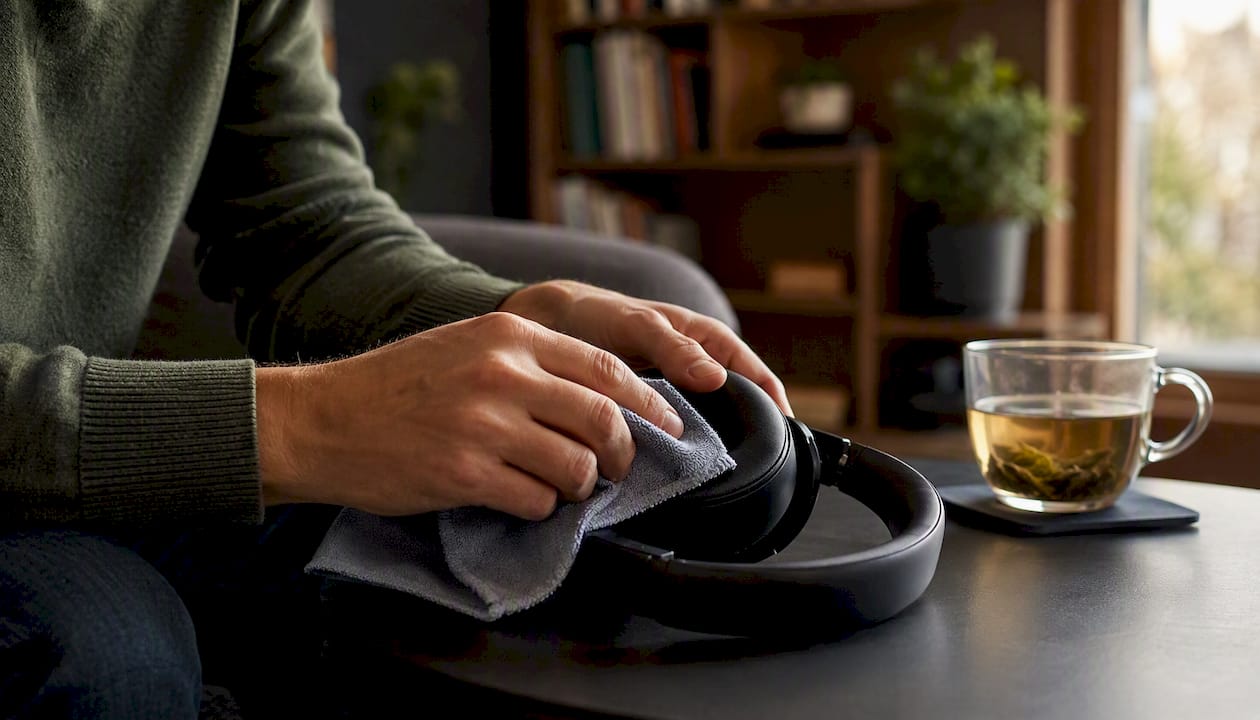
Open-back cups are more vulnerable to dust and moisture reaching the driver directly, so keep them in a case and wipe pads down regularly. Closed-back models are far more likely to fold flat and ship with wireless or ANC hardware built in, while open-back remains mostly a wired, at-home category. Comfort splits the same way: open designs ventilate better over long sessions, but closed designs can trap heat and create noticeable pressure against glasses arms after an hour or two.
One Listener’s Take on Living With Both Types
Most serious listeners end up owning one of each rather than forcing a single pair to do everything. Open-back stays home for critical listening and mixing; closed-back goes in the bag for anywhere else. That split isn’t a compromise so much as an acknowledgment that no single design wins in every room.
Closed-Back and Wireless Options Worth a Look
If your listening life is mostly commuting, open offices, or anywhere isolation matters more than maximum soundstage, Egwat’s closed-back lineup is built around exactly that scenario: sealed cups, active noise cancellation, and battery life long enough to survive a full workday without a charger.

The Premium Retro Over-Ear Headphones pair ANC with 40 hours of battery life, a combination that solves the two biggest closed-back complaints, isolation and heat, without asking you to plug in every few hours. If you’d rather compare specs side by side before deciding, Egwat’s full headphones collection lets you check driver type, battery life, and ANC strength across every model, and most orders ship fast enough that you can audition your pick at home and return it within the window if the fit isn’t right.
Frequently Asked Questions
Is open-back or closed-back better for gaming? Open-back generally wins for competitive gaming because the wider soundstage helps you place footsteps and gunshots more accurately. Closed-back makes more sense if you share a room or play with a headset mic in a noisy environment.
Can other people hear what I’m listening to on open-back headphones? Yes. Open-back headphones leak sound noticeably at moderate to high volumes, and someone sitting a few feet away can often identify the track playing.
Do closed-back headphones really sound worse than open-back? Not worse, different. Closed-back trades soundstage width for isolation and bass reinforcement, which is exactly what you want on a commute even if it’s not the most spacious presentation at home.
Is it worth buying both open-back and closed-back headphones? For many listeners, yes. A closed-back pair covers travel and recording, while an open-back pair handles critical home listening, since the two designs rarely satisfy both needs equally well.
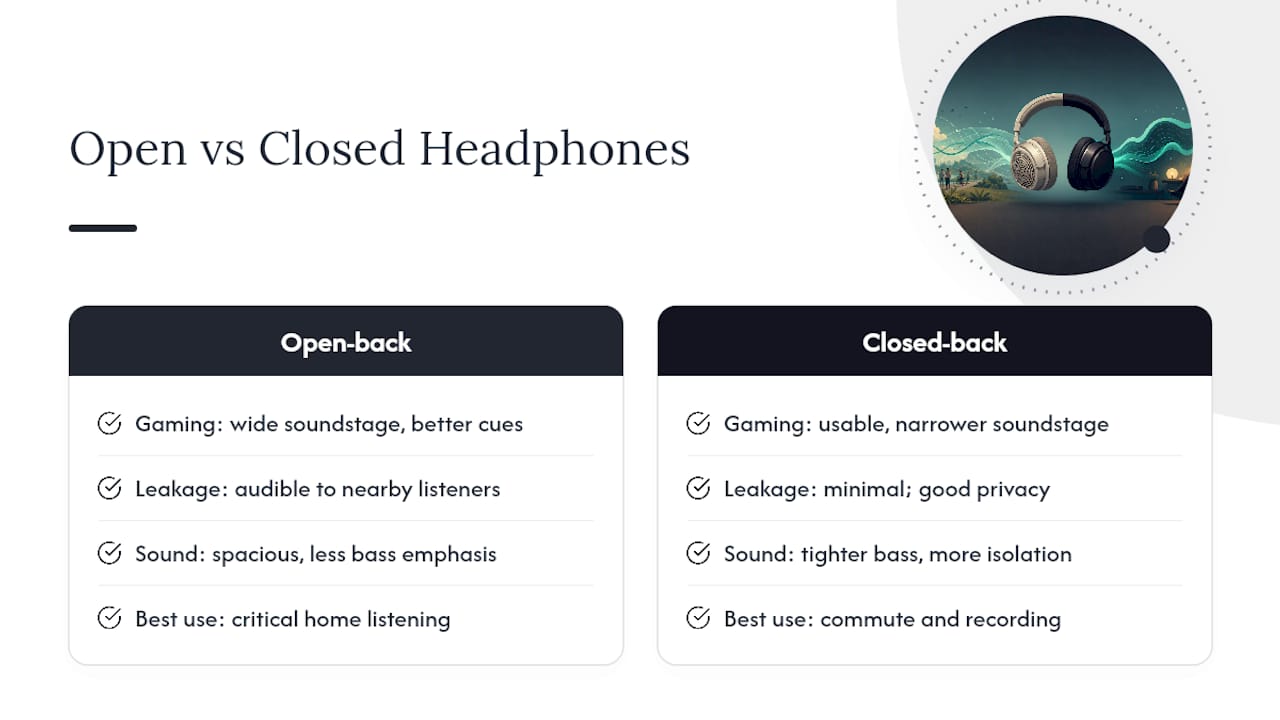
What is semi-open and should I consider it? Semi-open partially vents the cup to blend some open-back staging with reduced leakage, but results vary heavily by model, so audition before assuming it splits the difference perfectly.
Sources
- Rtings
- Open back vs Closed back headphones: Which is best? - SoundGuys
- Closed-back vs open-back headphones: which is right for you? | What Hi-Fi?
- Open-Back vs Closed-Back Headphones: The Complete Guide | The Audio Spec Lab